Archaeology South-East
Projects and Research
.
 

Kingshill South, Cirencester

Archaeology South-East undertook an archaeological evaluation at this site during October 2006. The work was undertaken on behalf of Berkeley Strategic Ltd in advance of the determination of a planning application for the development of the site.

The site was considered to have the potential for archaeological remains of prehistoric, Roman and medieval date. Early prehistoric occupation of the area is attested by a number of finds of artefacts, including stone axes and leaf-shaped arrowheads. Cropmarks interpreted as possible round barrows of Bronze Age date lie one kilometre to the south of the site and further cropmarks within the area probably represents Iron Age or Romano-British occupation. The site lies on the edge of the historic town of Cirencester (Roman Corinium), founded as a Roman town in the 1st century AD and the Roman road of Ermin Street runs directly to the south of the site.

A total of sixty-nine trial trenches were excavated across the site as part of the archaeological evaluation. The earliest identifiable activity on the site proved to be of Bronze or Iron Age date and comprised a wide but shallow ditch on a northwest-southeast orientation and located towards the western edge of the site


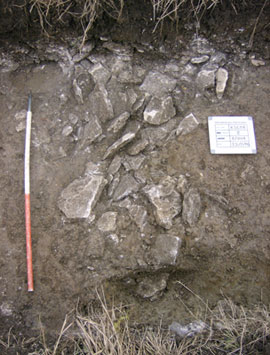
Romano-British activity on the site proved fairly extensive. Much of the activity of this period appears to be related to an extra-mural settlement, centred in the far north of the site, to the east of the walled town of Corinium (modern Cirencester). Here quantities of Roman building material, potential masonry foundations and associated pottery attest to the existence of a masonry building in the immediate vicinity. Further settlement may be evinced by significant quantities of Roman material retrieved from a number of pits to the southeast of the site but this is far from conclusive. The remaining activity of Roman date observed during the fieldwork appears to be largely agricultural in character and ditches and possible quarry pits.

No concrete evidence of activity dating to the Saxon, medieval and post-medieval periods but this is considered here to reflect the well-documented agricultural usage of the landscape during these periods.

Project Officer: Darryl Palmer
Client: Berkeley Strategic

Probable Roman wall foundation revealed during trial trenching  


Loading GoogleMap...


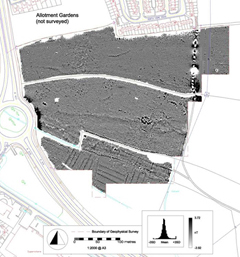
Fluxgate gradiometer plot from Kingshill SOuth

. Quick Links


  Archaeology South-East - Units 1 & 2 - 2 Chapel Place - Portslade, Brighton - East Sussex - BN41 1DR
Phone: 01273 426830 - Fax: 01273 420866 - Email: fau@ucl.ac.uk
Copyright © 2006 Archaeology South-East
Disclaimer | Accessibility | Help