| |
Rape of Hastings
Progress Report relating to Battle Urban SynthesisOctober 2008
The research element contained within the first phase of the English Heritage funded survey of Vernacular Architecture in a 250 square mile area of East Sussex known as the Rape of Hastings, is targeted towards the two urban centres of Battle and Hastings – the other two centres within the Rape have already been analysed; Winchelsea as an English Heritage funded project (Published 2004) and Rye (separately funded
by the Romney Marsh Research Trust
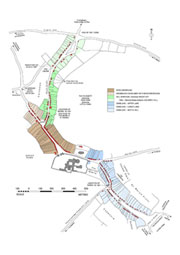
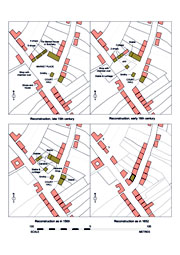
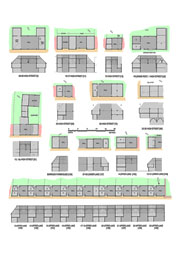
- see below). Work is currently concentrated on the monastic town of Battle, founded soon after the Battle of Hastings with the objective of servicing the abbey built on the site of the battle. Using documentary sources, it has been possible to reconstruct the layout of the town for c .1105, 1369, 1433, 1569 and 1730, not only indicating the number of dwellings at each date, but also their distribution. The demise of the market and the infilling of the market square late in the 15 th century has also been traced. The task now is to set the surviving buildings into this topographical background. Sadly, no domestic buildings survive within the town from before c .1400, but from that time onwards survival is good and includes 22 medieval houses.
Rye Urban Synthesis
During much of 2008 the main thrust of the urban synthesis relating to the Vernacular Architecture in the Rape of Hastings has centred on the Cinque Port town of Rye, the synthesis of which has been part funded as part of a Romney Marsh Research Trust project. From an architectural point of view Rye is the most significant of the towns within the Rape. Located upon a tiny 35-acre ‘island' site, the number of houses in the town doubled over a short period in the 16 th century, making it the largest port on the south-east coast at that time. In terms of its number of households it rivalled even Canterbury. The town's period of prosperity was short lived, and in the 17 th century it shrank back to its former size, but many of the 16 th -century houses remain. The available data allows an unusually complete picture to be reconstructed, indicating how a town of this type was able to cope with such pressures on its land. Most of the report on Rye is now written: final completion date is programmed for April 2009.
Project Officer: David Martin
Client: English Heritage
|
|






